
Persephone Pathworking
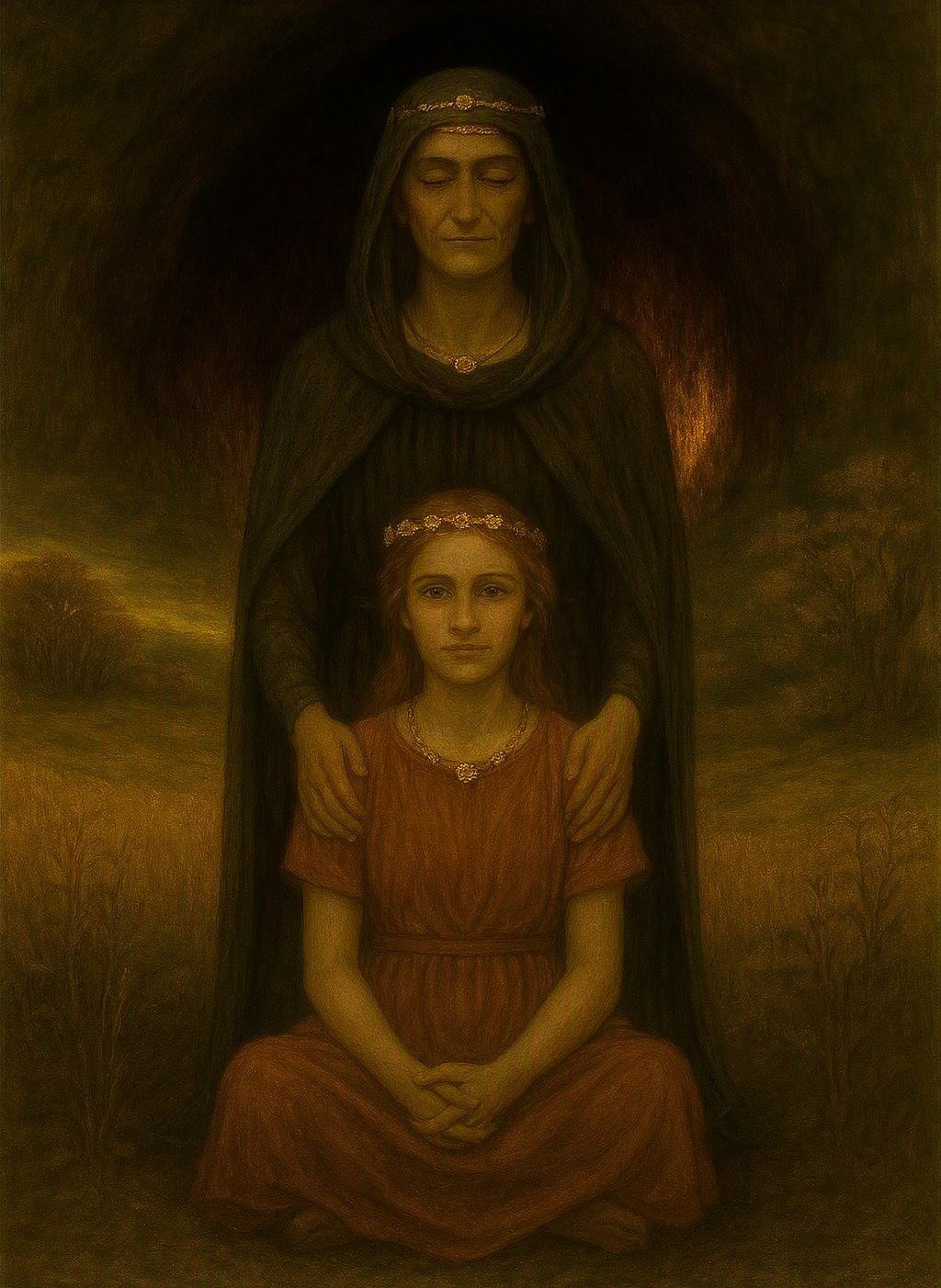
The Pattern
Across the many tellings of Persephone's story, a recurring theme emerges.
A young woman is separated from the life she knows and drawn into a world she did not choose. Her mother searches for her. The earth itself responds to grief. Eventually a compromise is forged, and a new rhythm emerges. Persephone spends part of the year above and part below.
Different traditions emphasize different aspects of the story. Some focus on loss. Others on power, initiation, grief, maturity, or transformation.
Yet regardless of the version, Persephone's story explores a question that many of us encounter:
How do we live with realities that cannot simply be removed?
The story does not end with a return to the way things were.
Instead, it asks whether a meaningful life can emerge when we learn to move between worlds.
Across the Myth
The Meadow
Persephone begins in a world that feels familiar.
Life has a rhythm.
The future appears predictable.
The world seems whole.
The Descent
Something changes.
The old world is disrupted.
The transition is not chosen.
A journey begins that cannot be reversed simply by wishing it away.
The Underworld
Persephone encounters realities she did not previously understand.
Loss.
Endings.
Uncertainty.
The hidden aspects of life.
What first appears frightening gradually becomes familiar.
The Search
While Persephone learns to live below, Demeter searches above.
The story reminds us that change rarely affects one person alone.
Every transition ripples through relationships.
The Compromise
No one receives exactly what they wanted.
Yet neither is everything lost.
A new arrangement emerges.
Not a solution.
A way of living.
The Cycle
Persephone belongs to both worlds.
The task is no longer choosing between them.
The task becomes learning their rhythm.
What If...?
What if some things cannot be fixed?
Many of us spend years trying to overcome difficult realities entirely.
Grief.
Change.
Uncertainty.
Loss.
Persephone's story points in another direction.
What if wisdom is not always found by removing difficulty?
What if it sometimes emerges through learning how to live alongside it?
What if adaptation is not the same thing as agreement?
Persephone adapts to the underworld.
This does not mean she wanted the journey.
Nor does it erase what was lost.
Sometimes adaptation is simply the process of learning how to continue.
Are there experiences in your life that you have learned to live with, even though you would never have chosen them?
What if cycles are not failures?
Modern life often encourages us to expect continual growth.
Continual energy.
Continual progress.
Yet the natural world moves in seasons.
The myth does too.
What if periods of withdrawal, rest, grief, or reduced capacity are not evidence that growth has failed?
What if they are part of the cycle?
What if winter has something to teach?
The underworld is dark.
But it is not empty.
Roots grow beneath the ground.
Seeds wait beneath the ground.
Water flows beneath the ground.
Many valuable things spend time hidden from view.
Are there parts of yourself that become visible only during difficult seasons?
What if noticing the season changes the experience of the season?
There is a difference between being surprised by winter and recognizing its approach.
One invites panic.
The other invites preparation.
Can you recognize the early signs of your own winter?
What helps you prepare?
What supports help you gather?
What commitments might need to be released?
What if belonging can take more than one form?
Persephone ultimately belongs to both worlds.
She cannot return completely to the life she once knew.
Yet neither is she entirely lost to it.
Many people discover that they too inhabit multiple worlds.
Who were you before a significant life change?
Who are you now?
Must one version disappear for the other to exist?
What if growth is sometimes hidden?
The most dramatic changes in the story occur beneath the surface.
Transformation happens where few can see it.
What changes are currently unfolding in your life that may not yet be visible?
Can you trust them before they flower?
What if wholeness includes darkness as well as light?
Persephone's story does not end with permanent spring.
The underworld remains.
Winter remains.
The cycle remains.
Yet so does life.
What would it mean to stop measuring wellbeing by the absence of difficulty?
What would it mean instead to measure it by your ability to participate fully in the life you have?
Notice
Which part of Persephone's story feels most familiar?
What "underworlds" have you visited in your own life?
What helped you navigate them?
Can you recognize the approach of your own winters?
What resources support you during difficult seasons?
What have you learned from periods you once wished to escape?
Which world do you currently inhabit?
What might it mean to move between them rather than choosing one?
Carry This
Winter does not mean spring has failed.
Some forms of growth require a season beneath the ground.
The task is not always to avoid the cycle.
Sometimes the task is learning how to travel with it.
Read the story Persephone Of Two Worlds
Return Home