
Merlin Between Worlds
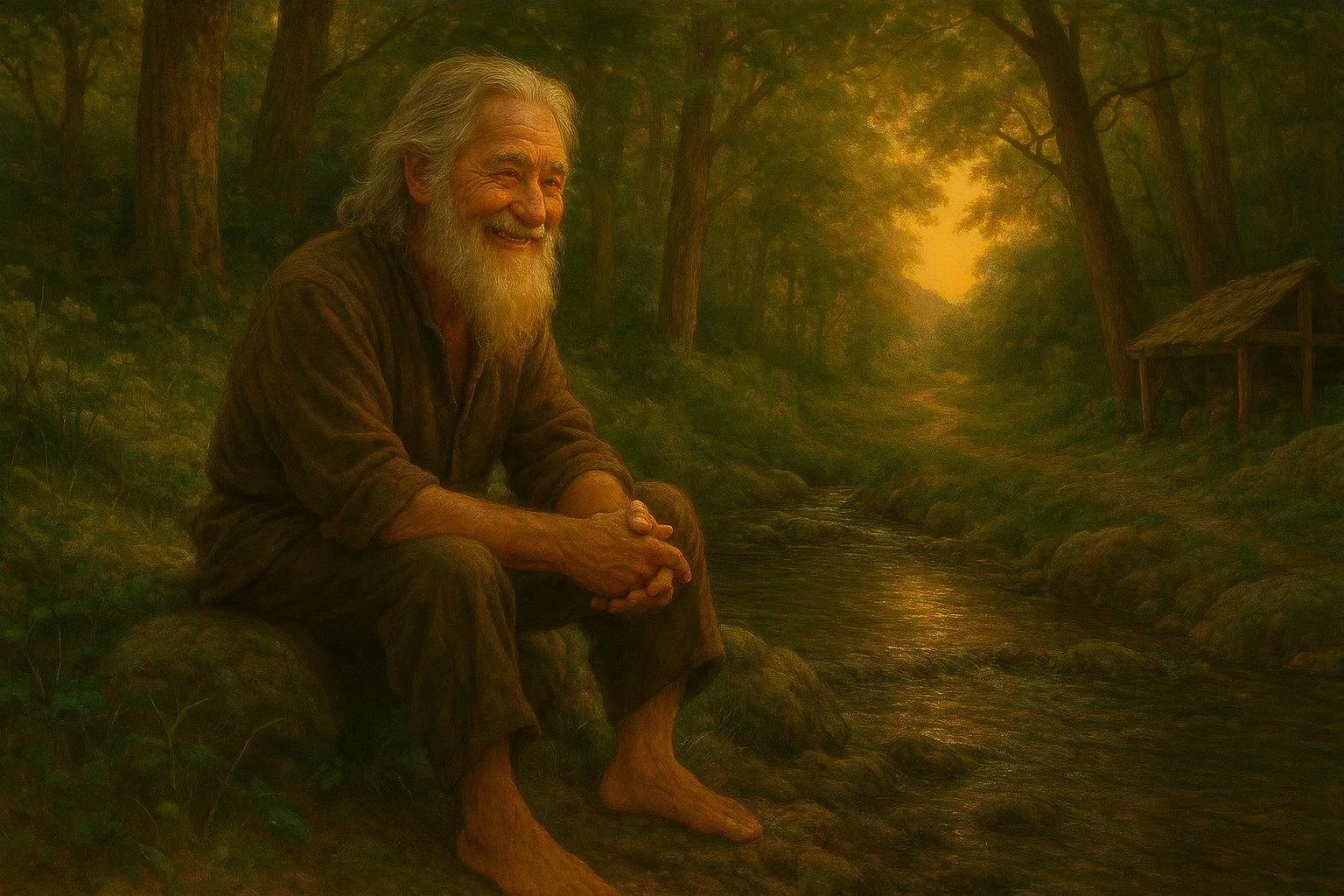
There was a time when I believed that understanding would make life easier.
When I was young, I thought confusion belonged to those who could not see. I thought certainty would arrive naturally if I simply looked carefully enough.
I know now that the opposite is often true.
Sometimes seeing creates difficulties of its own.
People tell stories about my birth. I have heard many versions over the years. Some speak of prophecies, some of demons, some of divine plans unfolding through unseen hands. I no longer concern myself much with which version is true.
What I know is simpler.
Before I was a man, before I was an adviser, before kings knew my name, I was simply a child who noticed things that others seemed not to notice.
That was enough.
Children are expected to inhabit the world as they find it. To accept its rules. To step into the patterns already in motion.
For reasons I did not understand, I rarely could.
I would ask questions adults found uncomfortable.
Why did one person speak differently when another entered the room?
Why did two people describe the same event in different ways?
Why did fear spread through a crowd faster than truth?
Why did some people seem stronger when they were alone than when they were surrounded by others?
I watched.
I listened.
I noticed.
And often I remained silent.
My mother worried about me.
Not because I was cruel.
Not because I was troublesome.
Because I seemed to live slightly to one side of the ordinary world.
She feared what others might think. She feared what might happen if my differences became too visible.
At the time I did not understand her concern.
I thought truth was enough.
I thought if something could be seen clearly, others would want to see it too.
Age has taught me otherwise.
People often want comfort before clarity.
Sometimes they want certainty before truth.
Sometimes they want neither.
My mother understood this long before I did.
I think she spent many years standing between me and the consequences of my own honesty.
I did not appreciate that at the time.
Few children do.
Years passed.
The world widened.
And eventually the world noticed me.
I cannot say precisely when that happened.
There was no trumpet announcing it.
No great turning of the heavens.
Only a gradual shift.
People who once dismissed my observations began to seek them.
People who once avoided my questions began asking questions of their own.
The change felt flattering at first.
Every person wishes to be seen.
What I had not yet learned was that being seen and being understood are not the same thing.
The distinction matters more than most people realise.
The first king who took an interest in me wanted answers.
At the time I believed that was because he valued wisdom.
Looking back, I think he valued certainty.
The kingdom was troubled.
Rumors spread through the court like wind through dry grass.
Fear had become its own form of governance.
Everywhere people searched for reassurance.
Predictions.
Guarantees.
Someone to tell them what would happen next.
And so they turned toward anyone who appeared capable of providing them.
Including me.
The strange thing about insight is that people often imagine it functions like a torch.
They think it illuminates everything equally.
In reality it behaves more like moonlight.
It reveals some things while obscuring others.
What I could offer was rarely certainty.
Only perspective.
Yet perspective was enough to make me useful.
And usefulness can be dangerous.
Being useful feels good.
It creates belonging.
It generates invitations.
It convinces you that you matter.
And often you do.
But usefulness has a way of growing.
The more capable you appear, the more the world asks of you.
One problem becomes two.
One responsibility becomes ten.
One request becomes expectation.
At first I accepted this willingly.
Perhaps even eagerly.
It felt meaningful.
It felt necessary.
There were always kingdoms to advise.
Conflicts to interpret.
Plans to consider.
Questions to answer.
And besides, I thought this was what one did with gifts.
What good is vision if it remains unused?
What good is understanding if it serves no one?
Those seemed like sensible questions.
I still think they are.
The difficulty arose elsewhere.
No one had taught me a companion question.
What happens when everyone needs something from you?
The answer arrived slowly.
The way many truths do.
Not through revelation.
Through accumulation.
A conversation here.
An obligation there.
A hundred small moments gathering quietly beneath awareness.
I began noticing a strange pattern.
The more people sought my counsel, the less time I spent listening to myself.
The more essential I became to others, the more distant I became from my own life.
I do not mean this dramatically.
I was not miserable.
I was not broken.
I was simply moving further and further from something I needed.
Though I could not yet name what it was.
So I continued.
Kings rose.
Kings fell.
Kingdoms expanded and contracted.
Wars were proposed.
Wars were avoided.
The world continued in its endless motion.
And I remained useful.
For a long time I believed that usefulness and purpose were the same thing.
Many people believe this.
It is an easy mistake to make.
But eventually life presents evidence that the two are not identical.
The lesson arrived for me as exhaustion.
Not ordinary tiredness.
Something deeper.
The kind that settles beneath the bones.
The kind that no amount of sleep fully touches.
-
At first I resisted it.
As most people do.
I worked harder.
I explained more carefully.
I gave more of myself.
This made things worse.
The world does not always reward over-extension.
Sometimes it simply becomes accustomed to it.
And so I found myself standing at a threshold I had not anticipated.
One path led toward continued obligation.
The other led away.
Neither felt comfortable.
One afternoon I left the court.
No dramatic farewell.
No declaration.
I simply walked.
The forest was waiting.
That sounds more romantic than it really was.
Forests are not magical solutions.
They do not heal all wounds.
They do not answer every question.
Mostly they are places where fewer people ask things of you.
That can be remarkably clarifying.
The first weeks were difficult.
Silence has a way of revealing what activity conceals.
Without the noise of court life, I could finally hear my own exhaustion.
Without constant demands, I could finally notice how long I had been carrying them.
At first this felt like loss.
Later it felt like relief.
Months passed.
Then seasons.
The forest changed.
So did I.
There is a kind of wisdom that grows from participation.
The wisdom of cities.
Communities.
Families.
Shared endeavors.
I had spent much of my life cultivating that form of understanding.
The forest offered another.
Not superior.
Not inferior.
Different.
Trees are patient teachers.
Rivers too.
Neither rushes.
Neither argues.
Neither demands that reality become other than it is.
Living among such things altered me.
Or perhaps allowed me to become what I had been resisting all along.
I began to notice that many of my struggles had emerged from the same source.
I had spent years attempting to fit entirely into worlds that only partially suited me.
The court required a version of myself.
The wilderness required another.
I kept treating these as competing loyalties.
As though one had to win.
As though belonging to one world required abandoning the other.
The solution, when it appeared, was surprisingly simple.
Not easy.
Simple.
I belonged to both.
And entirely to neither.
The forest was not an escape from civilisation.
Nor was civilisation a betrayal of the forest.
I could move between them.
I could advise when needed.
Withdraw when necessary.
Participate without surrendering myself.
Rest without disappearing.
For a long time I had imagined life as a problem to solve.
A final answer to discover.
A role to perfect.
The older I became, the less convincing that notion appeared.
Life seemed less like a puzzle and more like a landscape.
The goal was not mastery.
The goal was learning where one could live.
This is what age eventually taught me.
Not certainty.
Not power.
Not prophecy.
Only this:
Most people spend years trying to become what the world expects.
Some spend years trying to escape what the world expects.
A few discover a third path.
They learn to negotiate.
To participate without complete surrender.
To honour both their strengths and their limitations.
To create lives large enough to hold their contradictions.
I think I spent much of my life searching for that possibility.
The forest helped me find it.
Not because it provided answers.
Because it provided room.
And sometimes room is enough.
Looking back now, I understand something I could not have understood as a child.
The goal was never to see everything clearly.
The goal was learning how to live with what I could see.
There is a difference.
And in that difference, a life can be built.
This retelling draws inspiration from the medieval Merlin traditions, particularly Geoffrey of Monmouth's Vita Merlini (The Life of Merlin), alongside later Arthurian material.
Readers interested in exploring the traditional stories may wish to read:
Geoffrey of Monmouth, The Life of Merlin (Vita Merlini) (c. 1150) [sacred-texts.com], [globalgreyebooks.com]